What Hendersonville-area homeowners actually pay
Henderson County's manufactured housing runs from older single-wides on family land in Edneyville and Dana to park homes along the US-64 corridor east of Hendersonville and newer doublewide placements on rural tracts outside Flat Rock. The condition of the ground those homes sit on varies as much as the terrain does — and so does what re-leveling costs.
| Scope of work | Typical Henderson County range | What drives it |
|---|---|---|
| Re-level, single-wide | $400 – $1,200 | Number of out-of-level support points, crawlspace access, pier condition |
| Re-level, double-wide | $700 – $2,000 | Span width, pier count, whether the marriage wall has shifted |
| Replace failed piers or pads | $2,500 – $5,000 | Number of failed pads, footing prep required, soil condition |
Those are typical market ranges, not quotes. A contractor who names a number before walking the lot and inspecting the crawlspace is pricing the job blind. The table reflects what leveling crews actually find: a single-wide on flat, accessible ground with intact concrete pads lands at the low end of that first row. A double-wide on a hillside with freeze-cracked footings and two bad pads lands near the top of the second row or into the third.
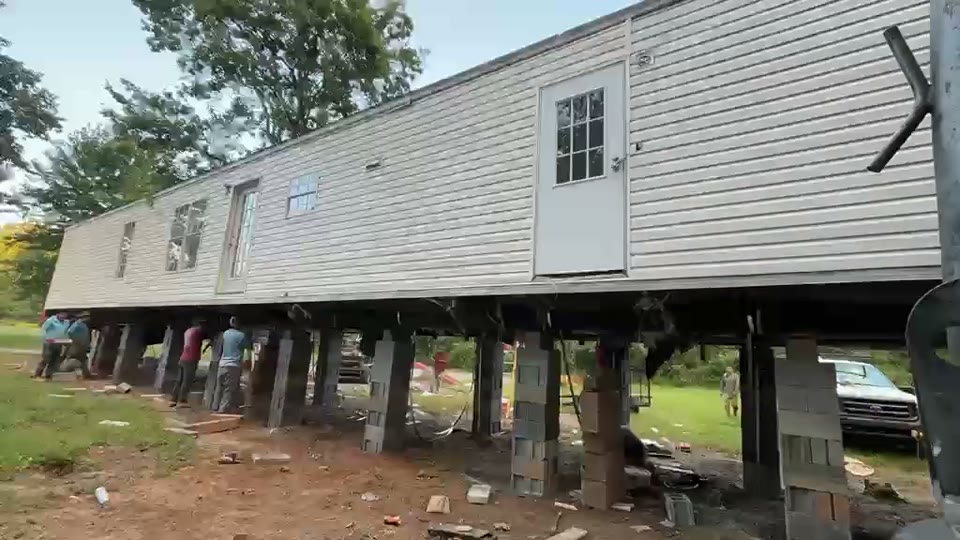
The jump between the second and third row marks the difference between adjusting existing support and replacing it. Replacement means removing damaged piers, rebuilding or recompacting the footing, setting new pads, and reinstalling supports to the home's installation-manual specification. That scope change is why the price shifts so significantly once a pad inspection confirms structural failure.
What moves the price on real Henderson County lots
Visible lean is almost never just routine settling — it usually traces to something happening at or below the pad. Three factors separate a $500 adjustment from a job that climbs toward the top of the range:
Freeze-thaw at elevation. Hendersonville sits at roughly 2,100 feet. Ground that saturates in fall rains, freezes through January and February, and thaws through March expands and contracts around piers repeatedly. Concrete block piers crack under that pressure; steel pads tilt as soil cycles through moisture and temperature. This is not a once-a-decade event at this elevation — it happens every winter of any consequence, and the cumulative effect builds up in support systems that haven't been inspected in several years.
Storm saturation and footing wash-out. Henderson County carries 16 federally declared disaster events over 1978-2026, including hurricanes in 2019, 2020, and 2023, a tropical storm in 2024, and a winter storm in 2026. Each of those events saturated pier footings, washed fill from under pads on bottomland lots like those along Mud Creek and Cane Creek, or placed load on homes already sitting on aging support systems. A home that shifted noticeably after any of those storm years likely has pad or footing damage, not just a leveling issue that shims will solve.
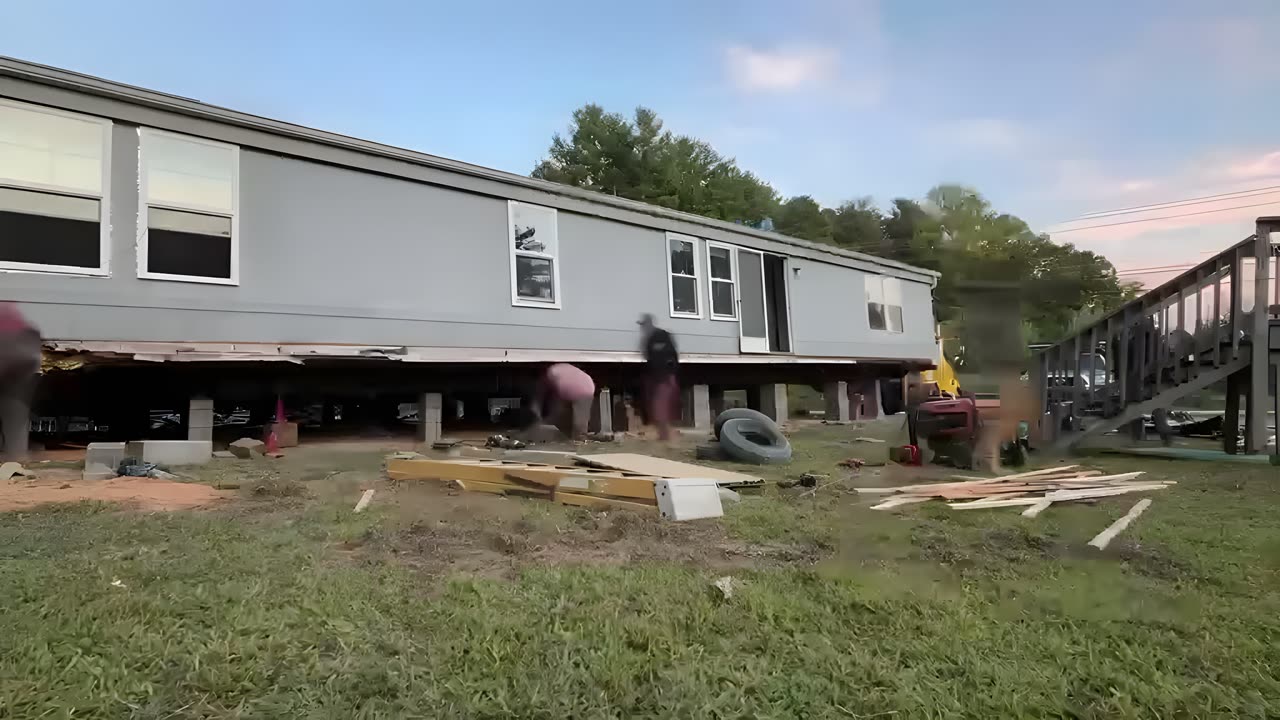
Crawlspace access and doublewide marriage wall. Low clearance on a sloped lot can double the labor time a crew spends under the home compared to a flat lot with standard clearance. When a doublewide settles unevenly, the marriage wall — the seam where both sections join — racks out of plumb, stressing interior finish and the structural connection between sections. Correcting it requires sequenced leveling from multiple points, sometimes including releasing interior connections before the re-level can proceed. That adds time and justifies a higher price per support point than a straightforward single-wide job.
Quotes that don't account for these variables are not cheaper — they are incomplete. Ask every bidder how they factored in access difficulty and what they found when they inspected the pads.
Licensing, codes, and Wind Zone I compliance
Re-leveling work that involves replacing or adjusting structural support piers and pads is regulated installation work in North Carolina. The NC Manufactured Housing Board, part of the Office of State Fire Marshal, licenses manufactured home installers and sets the standards for this category of work. A general contractor or handyman without a Manufactured Housing Board license is not legally doing structural support work on a manufactured home in this state — regardless of price or how routine the job looks from the outside.
Federal standards apply on top of state licensing. The HUD Office of Manufactured Housing Programs sets minimum installation requirements that continue to govern existing homes when work disturbs their support or anchoring systems. Henderson County is classified as HUD Wind Zone I under 24 CFR 3280.305, a designation that sets the minimum anchor and tie-down density for each home's size, roof pitch, and wall configuration. A leveling job that loosens or removes anchor straps — which commonly happens when adjusting piers near corners — must restore those straps to Wind Zone I specification before the work is complete. Leaving them unrestored puts the home out of compliance with its own installation manual, and that is what an insurer or a future buyer will surface in a proper inspection.
Before any contract is signed: ask for the NC Manufactured Housing Board license number. In a market where storm seasons bring unlicensed operators willing to work cheap, that one question does most of the filtering.
What to confirm before any work starts
Three moves protect a Henderson County homeowner before a re-leveling job begins:
- Pad inspection before pricing. Any contractor worth hiring starts under the home, not with a corner-to-corner level reading. The purpose is to identify which pads have cracked, which have tilted, and which are still serviceable — because that answer determines whether the job is a re-level or a replacement. A quote that doesn't account for pad condition is almost certainly priced for the wrong scope.
- Price per support point. Pad counts sometimes change once a crew is under the home and finds conditions the exterior inspection missed. A per-point price structure keeps change orders honest. A fixed job quote on a crawlspace that hasn't been inspected in years creates the wrong incentive for the contractor once they see what's actually down there.
- Drainage in scope. A quote that addresses the lean without addressing why the pads moved is a quote for doing the job again in three to four years. If the lot shows pooling, uphill runoff, or soft soil near the piers, those conditions belong in the scope of work — not left for the next crew to find.
If a quote lands well above the ranges in the table, ask for the reason. Terrain, access difficulty, and extent of pad damage can justify it, and how a contractor explains the gap tells you more than the number alone. For the statewide comparison, our mobile home leveling cost guide for North Carolina shows where Henderson County ranges sit relative to the rest of the state. For what a proper re-leveling involves from start to finish, the re-leveling process guide walks through each step. For service details specific to this area, mobile home leveling in Hendersonville NC covers what to expect locally.
When to schedule an inspection before costs climb
Henderson County mobile homes rarely announce leveling problems loudly. The early signs are mundane: doors that used to close cleanly start catching on the frame; windows develop gaps or won't latch; floors feel soft in a section that used to feel solid. In doublewides, the marriage wall may develop a new crack along its seam, or a gap opens at the ceiling line on one side. None of those symptoms feel urgent — until the next freeze cycle works further into a pad that has already started to fail.
At Hendersonville's elevation, a home showing early-stage lean going into December is a home that will show more lean coming out of March. Scheduling an inspection in September or October keeps most jobs in the re-leveling price range. Waiting until the following spring after a full winter cycle often moves the scope into pad replacement territory and sometimes to the top of that range.
If the home sat through any of the recent hurricane or storm seasons without a post-storm inspection — particularly if it sits on bottomland near Mud Creek or on a slope above a drainage course — that alone is reason enough for a look. The cumulative effect of repeated footing saturation does not always announce itself until a threshold is crossed and the lean becomes visible from the driveway.