What leveling typically costs around Mills River
Mills River sits in the agricultural valley between Hendersonville and Brevard, where NC-280 and NC-191 converge before climbing into the Blue Ridge. Manufactured homes here are typically on rural lots with older pier-and-pad foundations — often set years ago and never touched since. That combination produces predictable settling, and predictable pricing.
For most jobs in the area, the table below reflects what honest leveling work actually costs. A tighter estimate always requires a look underneath — pier count, pad condition, and soil type all vary lot to lot. Full line-item ranges are on the NC mobile home leveling cost page.
| Scope | Typical Range | What Drives It Higher |
|---|---|---|
| Single-wide re-leveling, piers intact | $400–$1,200 | Access difficulty, above-standard pier count |
| Double-wide re-leveling, piers intact | $700–$2,000 | Marriage-line shimming, ridge-beam correction |
| Partial pier or pad replacement | $2,500–$3,500 | Soil prep, multiple failed pads |
| Full pier-and-pad replacement | $3,500–$5,000 | Whole-home re-setup, widespread foundation failure |
Any quote that skips a crawl-space inspection is a guess, not a scope. A crew that prices over the phone without looking at pier condition is pricing the easy version of your job.
What the home tells you before you call anyone
Most leveling calls in Henderson County start the same way: a door that used to latch now catches on the frame. That is the home talking. The signs worth acting on are doors and windows that stick or gap on one side, a noticeable slope when you set a ball on the kitchen floor, visible daylight between the skirting and the ground on one end of the home, and — on double-wides — cracks running along the marriage line where the two sections meet.
Seasonal movement is common and usually minor — the home shifts a little in wet winters and settles back in dry summers. Movement that compounds year over year, a gap that grew or a crack that widened, is structure. The re-leveling process guide covers what a baseline inspection should document so you know which category you are dealing with.
Water under the home accelerates everything. Henderson County has recorded 16 federally declared disasters over 1978-2026, most in the storm and hurricane family — the wet seasons that follow those events are exactly when pier soil softens and pads shift. A home that came through those years already unlevel is already behind.
How a leveling job actually unfolds
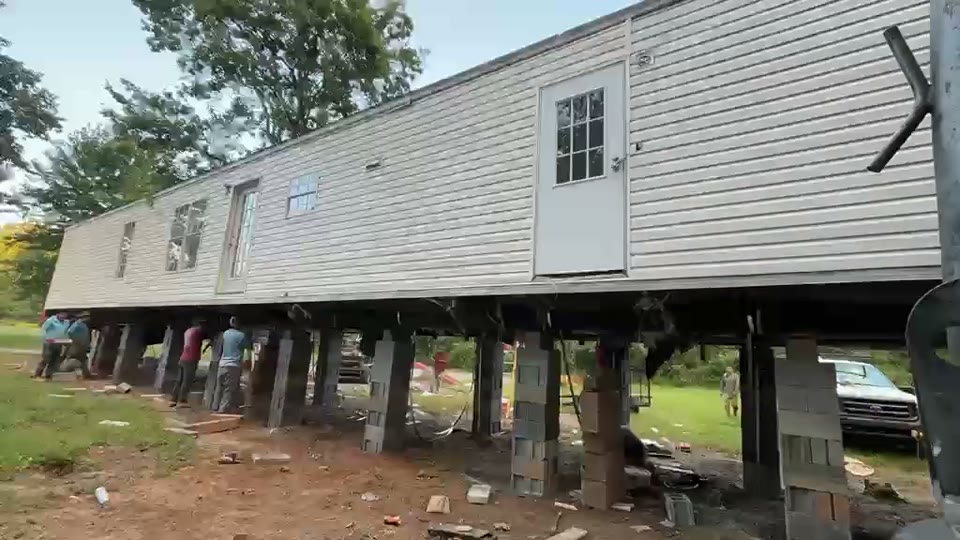
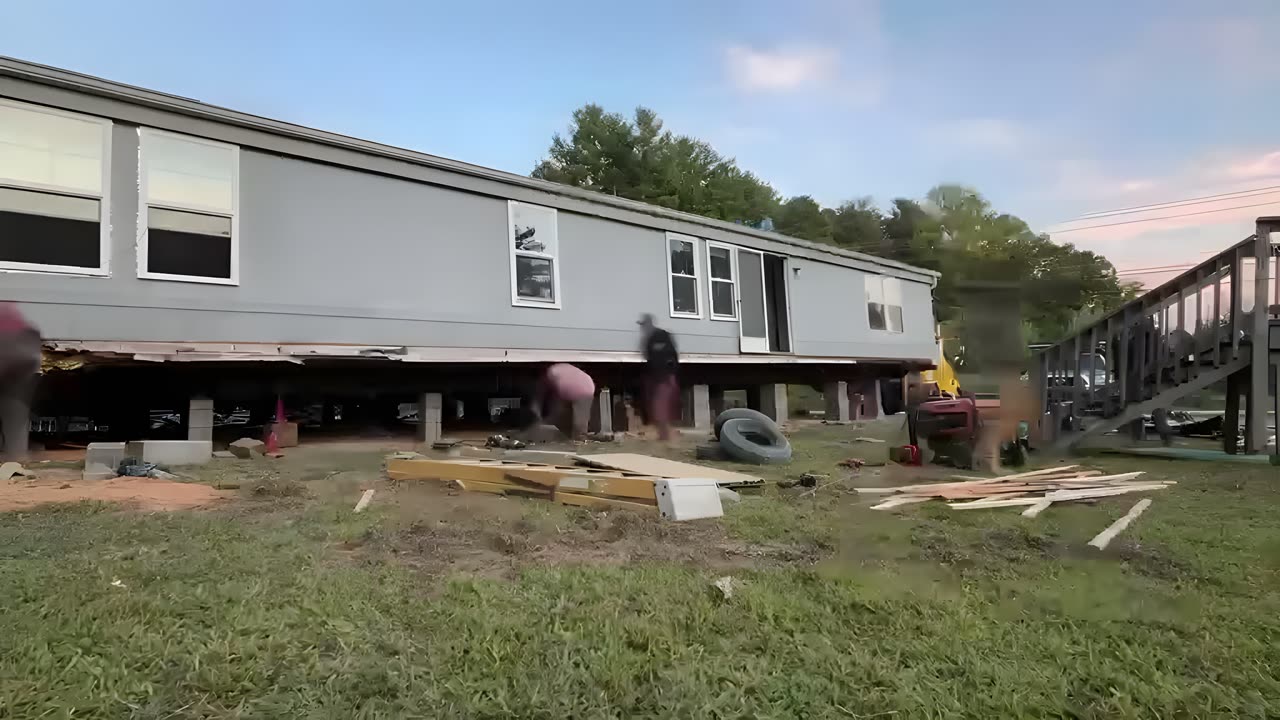
The work sequence is straightforward but leaves no room for shortcuts. A crew runs a laser transit or digital level to map exactly how far each corner and mid-span point has settled relative to the original reference. From that map, they place hydraulic jacks at the low points and lift in small controlled increments — a few fractions of an inch at a time to avoid torquing the frame — then shim or replace the piers and pads that have failed.
On a single-wide, a standard leveling job can run a few hours if the piers are sound and just need shimming. A double-wide adds the marriage-line check: the two sections have to be brought into alignment before the center beam and roof load read correctly. Replacing failed concrete pads or installing new adjustable steel piers adds materials and time, which is where jobs move toward the higher end of the cost ranges.
The finished work should leave the home within the tolerances set by the manufacturer and consistent with the setup standards enforced by the NC Manufactured Housing Board. A crew that cannot point to those standards when asked is not a crew you want under your home.
Henderson County's storm record and what it means for your piers
Henderson County's manufactured homes carry a documented storm history that most flatland leveling averages do not price in. Federally declared incidents in recent years include a Winter Storm in 2026, a Tropical Storm in 2024, and Hurricanes in 2023, 2020, and 2019. Each event delivers saturated soil and sustained wind loading — two forces that work steadily against pier-and-pad stability. The NOAA National Weather Service data for the western North Carolina mountain corridor reflects a persistent pattern of heavy precipitation events concentrated in this valley.
The relevant code anchor for this county is HUD wind zone classification. Henderson County falls in Zone I under 24 CFR 3280.305 — the standard designation for most of the interior Southeast. That classification governs both the original installation tie-down requirements and what any re-setup after a move or major leveling must meet. If a contractor's proposal does not reference wind zone compliance, ask specifically whether the finished job will satisfy it. The HUD Office of Manufactured Housing Programs publishes the full installation standard.
The Henderson County permit checklist
A leveling job on an existing, in-place home is not the same permit event as a new setup or a county move — confirm with Henderson County Development Services whether your specific scope requires a permit before work starts. When a move is involved, the list is longer.
For a move within Henderson County, the checklist runs: zoning clearance from Henderson County Planning or the town if the destination parcel falls inside Mills River town limits; an Environmental Health sign-off confirming the existing septic system can serve the home, or a new-system approval; water and sewer tap receipts if the site connects to municipal lines; the permit application with the installer's NC Manufactured Housing Board authorization number; and the County Assessor's moving permit, which triggers the tax-paid clearance required under NCGS Chapter 105, Article 18.
If the move travels on NC-280, NC-191, or any state-maintained road, a transport permit from NCDOT is required before the home moves. The current requirements are in NCDOT Publication MH-2. A move without that permit is an uninsured move — no legitimate hauler proceeds without it.
Questions worth asking before anyone lifts a beam
The Mills River and greater Henderson County market has several crews who handle leveling alongside moving and full-setup work. The quality gap is real. Three questions separate the thorough from the quick: Does the crew inspect under the home before quoting, or price by size alone? Can they recite the pier count and pad condition after looking, or do they have to go back and check? And do they know whether your specific scope requires a permit under current NC Manufactured Housing Board rules, or do they leave that discovery to you?
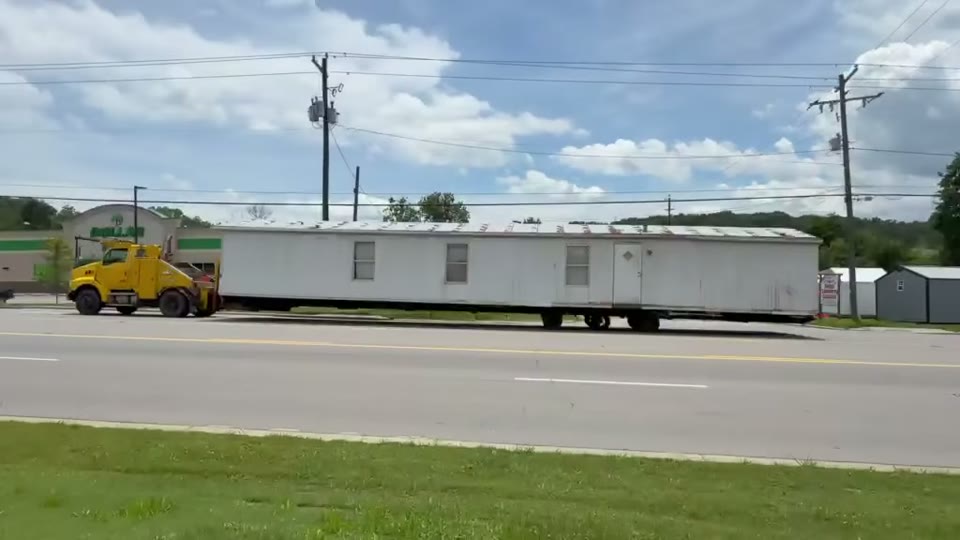
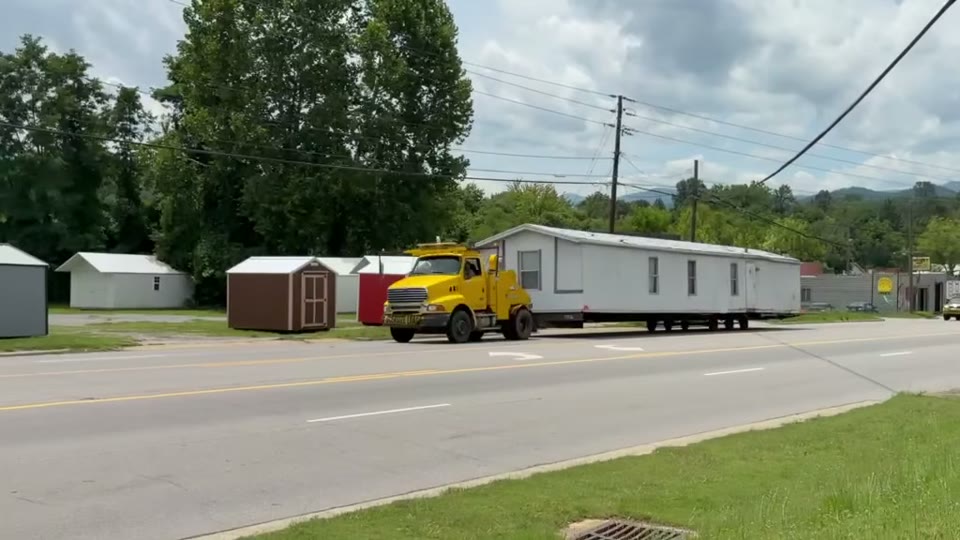
If you are also moving the home — or need a crew that can handle both transport and setup — the Mills River mobile home movers page covers what to ask the hauler before you book, including the HUD Data Plate requirements that govern legal re-setup after a transport.
Price questions come up before anything else in this market. Most re-leveling around Mills River lands within the ranges on this page, and the jobs that go beyond them are the ones where pier or pad failure was left too long. Catching it at sticking doors costs a fraction of catching it at a cracked marriage line.