What re-leveling costs in Franklin
Franklin is Macon County's county seat, sitting at the junction of US-441/23 and US-64 in the southern Blue Ridge, where the valley floor along the Little Tennessee River backs up into ridgelines on every side. The manufactured housing stock here skews older, and older homes on older pier systems in mountain terrain settle unevenly. That is the normal picture for most leveling calls in this county.
The most common job is routine re-leveling: hydraulic jacks, shims, and a few hours of work on a home whose piers and pads are still structurally sound. The less common but higher-cost job is finding that the pads have cracked or the piers have deteriorated, which turns a re-level into a replacement job. Both scenarios are in the table below.
| Scope | Typical Range | What pushes the cost up |
|---|---|---|
| Single-wide re-level, piers and pads sound | $400–$1,200 | Shim quantity, slope of lot, site access |
| Double-wide re-level, piers and pads sound | $700–$2,000 | Marriage-line realignment, distance from drive |
| Deteriorated piers or pads requiring replacement | $2,500–$5,000 | Pad count, soil condition, timber vs. concrete block |
For the full statewide breakdown of what moves these numbers, see the NC mobile home leveling cost guide. Jobs around Franklin seldom land at the low end of any range: lots in Macon County are rarely flat, and access on a steep mountain drive adds real time to every job.
What the home is telling you
The signs of a level problem in a manufactured home are easier to read than most owners expect. Start with the doors: one that latched without effort last spring and now requires a shoulder to close is the most reliable early indicator. Doors are attached to the structure, so the frame reveals what the floor plan hides. A marble or round pen set on the floor tells you how much slope has developed and in which direction.
At the exterior, watch for gaps between the skirting and the ground — sections that have lifted or separated — and on a double-wide, for visible gaps or cracking along the marriage line where the two units meet. Inside, cracking at the corners of windows and doorframes follows the stress lines created by differential settlement. On older homes, a visible bounce when walking across the center section signals that a girder or support pier has lost consistent contact with the pad below.
A level problem that reads as a minor inconvenience in its first season rarely stays that way. The structure of a manufactured home is designed to carry load in a level plane: once that plane tilts, stress concentrates at the connections between the floor system and the wall panels, at the corners of doors and windows, and along the marriage line on a double-wide. The longer the tilt runs, the more secondary damage accumulates.
How a leveling job actually works
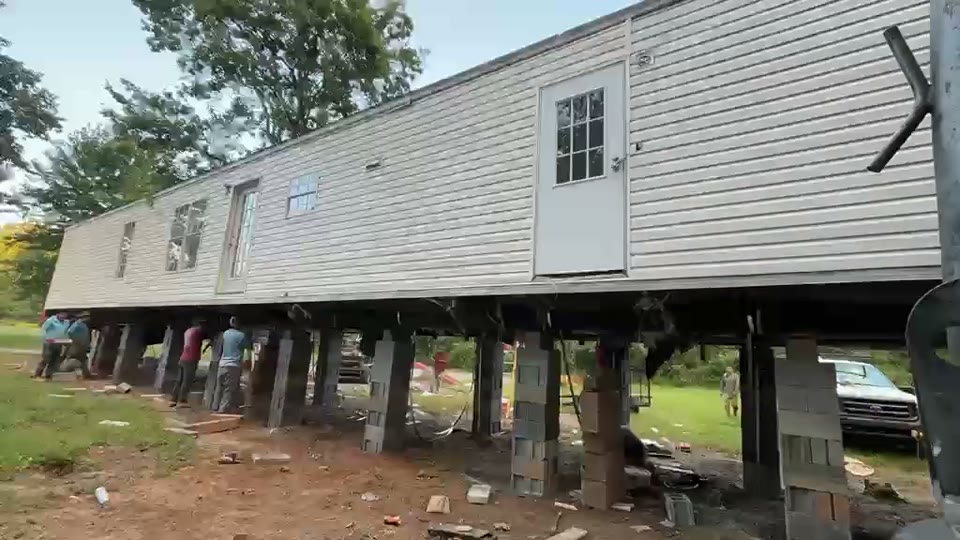
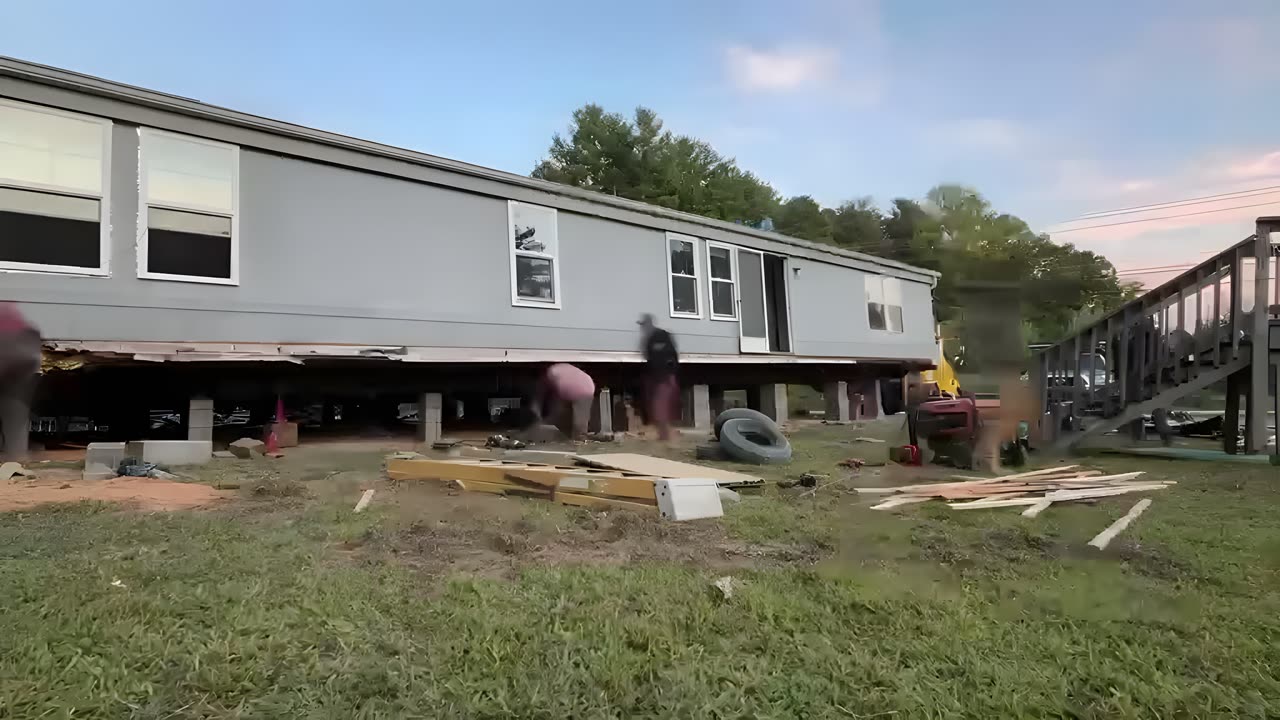
A crew works in sequence. Hydraulic jacks go under the steel chassis at the engineered load points; the low sections come up incrementally, with small lifts to avoid stressing wall panels, ceiling seams, and utility connections. Shims go under the piers to hold the new position. On a double-wide, the marriage line is monitored and re-secured throughout the process, since the two units can move independently as the home comes up.
When piers or pads have deteriorated past the point where shimming will hold, replacement precedes re-leveling. That work is distinct from a routine re-level and is covered in full on the mobile home re-leveling service page.
Macon County falls in HUD Wind Zone I under 24 CFR 3280.305, as established by the HUD Office of Manufactured Housing Programs. That classification governs the tie-down and anchoring standard for every manufactured home sited in this county. Any re-leveling that disturbs the anchoring system — removing ground anchors to access a pier, for example — must restore the system to Zone I compliance before the job is complete. Ask how the crew handles that step before work begins.
Storm history and what it does to the ground under your home
Macon County has 15 federally declared disasters on record across 1973-2026, with the pattern weighted toward storms: hurricanes in 2019, 2020, and 2023, a tropical storm in 2024, and a winter storm in 2026. Each of those events pushed water through the valley system that runs through Franklin, and saturated soil — even briefly — loses bearing capacity. A concrete pad holding a home level before a major rain event may not hold it the same way three months later, once the soil has reconsolidated under unequal load.
Post-storm leveling calls are a regular pattern in this part of the county, particularly for homes sited on filled or graded lots rather than undisturbed native ground. If your home has developed a lean or sticky doors in the months following any of the events above, that timing is worth mentioning when you request an assessment — it changes how a crew diagnoses what moved and why, and it affects whether re-shimming alone will hold or whether pad condition needs to be evaluated first.
Permits, licensing, and what to confirm before work starts
Leveling a home in place does not always require a permit the way new installation does, but Macon County's current requirements are not independently verified by this site. Call the county permit office directly before any work starts to confirm what documentation applies to your situation.
Contractor licensing is a separate and non-negotiable check. The NC Manufactured Housing Board, which operates under the NC Office of State Fire Marshal, oversees licensing for manufactured housing contractors statewide. Any company performing structural work on your home should hold a current license with the Board; verify that before signing anything.
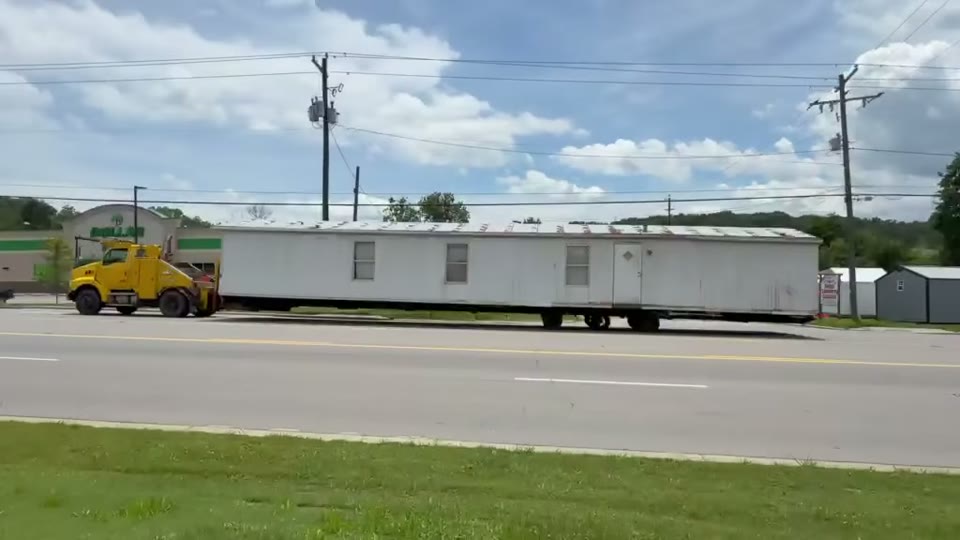
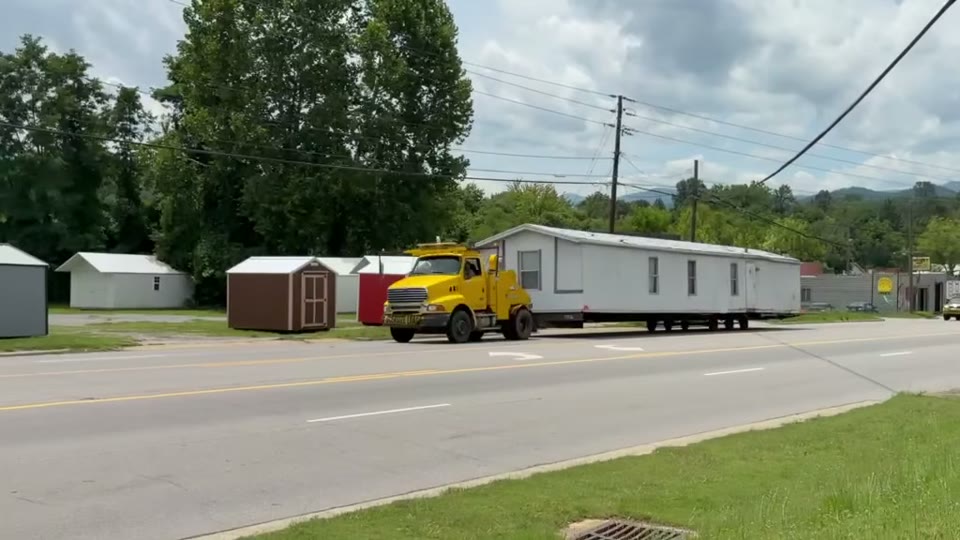
If the leveling job is connected to a home relocation rather than leveling in place, the picture changes significantly. NCDOT requires oversize-move permits under Publication MH-2, and a tax-paid moving permit under NCGS Chapter 105, Article 18 must be cleared before the home can legally move. The Franklin mobile home movers page covers the logistics and permitting side of a full relocation.
Three questions worth asking any leveling crew before work starts: whether they have experience with your specific foundation type; whether they will restore the anchoring system to Zone I compliance if they disturb it; and how they handle piers that turn out to be more deteriorated than the initial walkthrough suggested. How a crew answers the third question tells you whether they have a clear process or are pricing on assumptions they will revise mid-job.